
Executive Summary
U.S. government, commerce, and culture discriminate systemically against single people. This bias, also known as singlism[i], permeates laws, economics, healthcare, business, entertainment, and news media. A single person can easily spend over a million dollars more in her lifetime than her married peer, because of discriminatory federal legislation that privileges married people.[ii] Moreover, singlism does double harm to singles in marginalized groups already impacted by other “isms” like racism, sexism, ableism, and ageism—creating an exponential intersection of disadvantage.
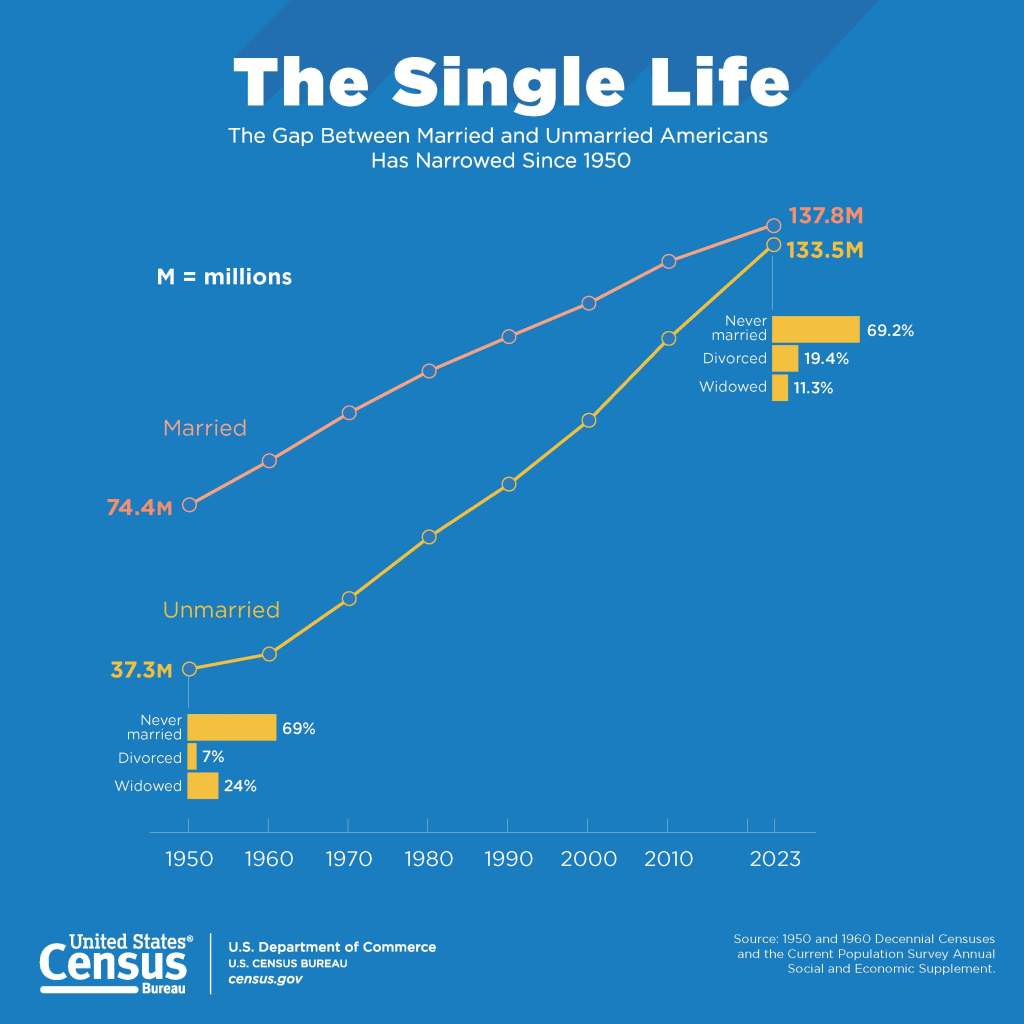
Single people have the right to be seen as equal under the law. They have the right to equal treatment in the workplace, Social Security system, tax code, and everywhere else where marital status is used to determine benefits and privilege. Technically, as U.S. citizens, single people already have all the rights listed in this Bill. The problem is those rights are not being exercised. Even though almost half the U.S. adult population is single, U.S. law treats the traditional nuclear family, rather than the individual, as the basis of society.
U.S. legal, financial, and health policies need to support all individual citizens, not arbitrary groupings of citizens (historically nuclear families). The Singles Bill of Rights is intended as a thought paper and resource for people who are trying to understand the extent of, and work to dismantle, discrimination against single people.
Singles’ unfulfilled rights include, but are not limited to:
- The right to equal pay.
- The right to equal taxation.
- The right to equal health, disability, bereavement, other benefits in the workplace and from commercial industries.
- The right to equal healthcare standards, costs, and benefits.
- The right to be charged equally for products and services.
- The right to claim benefits for loved ones equal to those allowed for spousal relationships, such as retirement benefits, family leave benefits, and loss of consortium benefits.
- The right to equal treatment, resources, housing, supportive services, and survivor benefits in the military and federal government—and in society at large.
- The right to diverse, affordable, and accessible housing, accommodation, and municipal service options for one person—or for more progressive, alternative, and non-nuclear family structures.
- The right to protection from discriminatory housing policies, such as limited occupancy laws that prohibit people not related by blood or marriage from living together.
- The right to protection from having one’s mental or physical health pathologized or criticized in research, clinical, or other medical/health settings—and in society at large.
- The right to file for legal protection regarding marital or romantic relationship status discrimination.
Copyright © 2025 by Singles Equality. This document may be freely copied and quoted in other publications as long as the source, Singles Equality, is given credit as its author.
More than 49% of Americans are single, according to the U.S. Census Bureau’s report on Marital Status of the Population 15 Years Old and Over, November 2024.
[i] Morris, W. L., DePaulo, B. M., Hertel, J., & Taylor, L. C. (2008). Singlism—Another problem that has no name: Prejudice, stereotypes and discrimination against singles. In M. A. Morrison & T. G. Morrison (Eds.), The psychology of modern prejudice (pp. 165–194). Nova Science Publishers (Accessed: 20250729)
[ii] Arnold, Lisa and Christina Campbell. “The High Price of Being Single in America.” The Atlantic, 14 January 2013, http://www.theatlantic.com/sexes/archive/2013/01/the-high-price-of-being-single-in-america/267043 (Accessed: 20250310)




 Singles Equality | Singles Bill of Rights